
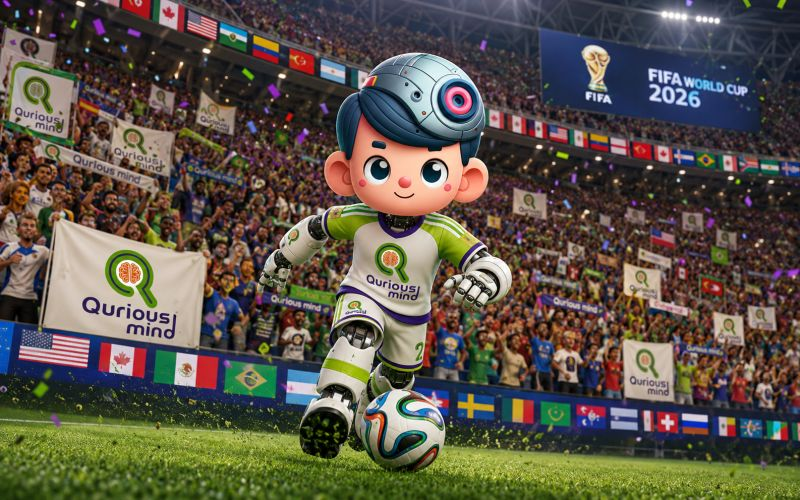
At first glance, Football Players and Robotics Engineers appear to have very little in common. One competes on a football field, while the other designs and builds innovative machines in a laboratory. However, when we look closer, we discover that both rely on many of the same skills to achieve success.
Understanding From Football Fields to Robotics Labs: Skills Shared by Athletes and Engineers helps students realize that success is not only about talent. It is about teamwork, problem-solving, strategic thinking and a commitment to continuous improvement.
At Qurious Mind Infotainment Pvt. Ltd., we believe robotics education is about much more than technology. It is about helping students develop the essential life skills needed to succeed in school, careers and everyday challenges.
About FIFA World Cup 2026™
The FIFA World Cup 2026™ marks a historic milestone as the 23rd edition of the world’s biggest football tournament. For the first time ever, the competition will feature 48 national teams, expanding from the previous 32-team format and making it the largest FIFA World Cup in history.
The tournament is being jointly hosted by Canada, Mexico and the United States, making it the first FIFA World Cup to be organized by three host nations. Scheduled to take place from 11 June to 19 July 2026, the tournament will feature an exciting 104 matches, giving fans around the world more football, more teams and more unforgettable moments than ever before.
Matches will be played across 16 host cities:
Canada: Toronto and Vancouver
Mexico: Mexico City, Guadalajara and Monterrey
United States: Atlanta, Boston, Dallas, Houston, Kansas City, Los Angeles, Miami, New York City / East Rutherford, Philadelphia, San Francisco (Bay Area) and Seattle.
Qualified Teams for the FIFA World Cup 2026™
A total of 48 teams have secured their place in football’s biggest global event.
AFC (Asia) – 9 Teams
Australia, Iran, Iraq, Japan, Jordan, Qatar, Saudi Arabia, South Korea and Uzbekistan.
CAF (Africa) – 10 Teams
Algeria, Cape Verde, DR Congo, Egypt, Ghana, Ivory Coast, Morocco, Senegal, South Africa and Tunisia.
CONCACAF (North, Central America & Caribbean) – 6 Teams
Canada (Host), Curaçao, Haiti, Mexico (Host), Panama and United States (Host).
CONMEBOL (South America) – 6 Teams
Argentina, Brazil, Colombia, Ecuador, Paraguay and Uruguay.
OFC (Oceania) – 1 Team
New Zealand.
UEFA (Europe) – 16 Teams
Austria, Belgium, Bosnia and Herzegovina, Croatia, Czechia, England, France, Germany, Netherlands, Norway, Portugal, Scotland, Spain, Sweden, Switzerland and Turkey.
With more participating nations, more matches and a truly global hosting format, the FIFA World Cup 2026™ promises to be the most inclusive and spectacular edition of the tournament ever held. Football fans across the world can look forward to witnessing new rivalries, emerging stars and unforgettable moments as the best teams compete for the sport’s most prestigious trophy.
What is common between Robotics and Football? One is played on a football field by athletes chasing a ball. The other is built with circuits, sensors, motors, and lines of code by young innovators. But look a little closer… What if we told you that the same skills that help a football team win the FIFA World Cup can also help a robotics team win a championship?
🤝 Teamwork Drives Success
Working Together Towards a Common Goal
No football team can win a championship based on individual talent alone. Players must communicate, support one another and work together to achieve a common objective. The same principle applies in robotics.
Students participating in robotics projects often work in teams where responsibilities are divided among members. Some focus on design, others on programming, while others handle testing and troubleshooting.
According to the National Association of Colleges and Employers (NACE), teamwork consistently ranks among the most important skills employers look for in graduates.
🧩 Problem-Solving Under Pressure
Finding Solutions When Challenges Arise
Football matches are full of unexpected situations. Teams must adapt to changing conditions, new strategies and unexpected setbacks. Similarly, robotics projects rarely work perfectly on the first attempt. Students often encounter challenges such as:
- Programming errors
- Sensor malfunctions
- Design flaws
- Competition constraints
These situations require critical thinking and creative problem-solving. The World Economic Forum identifies complex problem-solving as one of the most valuable skills for the future workforce.
🎯 Strategy Makes the Difference
Planning Before Taking Action
Successful football teams rely on strategy. Coaches carefully analyze opponents, create game plans and make tactical decisions throughout a match. Robotics projects require the same approach. Before building a robot, students must answer important questions:
- What problem are we solving?
- Which design is most effective?
- What sensors and components are required?
- How should the robot be programmed?
Strategic planning increases the likelihood of success and reduces costly mistakes.
📊 Continuous Improvement Leads to Excellence
Learning Through Practice and Refinement
Elite athletes spend years improving their performance through training, feedback and practice. Engineers follow a similar process. In robotics, students typically follow an iterative cycle:
1. Design
2. Build
3. Test
4. Improve
5. Repeat
Every version of a robot becomes better through testing and refinement. Research in engineering education has shown that iterative learning significantly improves both technical skills and problem-solving abilities.
💡 Learning From Failure
Turning Mistakes Into Opportunities
Every athlete experiences losses and setbacks. The most successful players use those experiences as opportunities to improve. The same is true in robotics. Robots may fail to complete tasks, programs may contain bugs and designs may need modification.
These challenges provide valuable learning experiences. Stanford University research on growth mindset shows that students who embrace mistakes as learning opportunities tend to perform better over time.
Why These Skills Matter for the Future
The skills highlighted in From Football Fields to Robotics Labs: Skills Shared by Athletes and Engineers are becoming increasingly important in today’s world. Employers consistently seek individuals who can:
- Collaborate effectively
- Solve problems creatively
- Think strategically
- Adapt to change
- Continue learning
These are precisely the skills developed through both sports participation and robotics education. As technology continues to transform industries, these human-centered skills will remain critical for future success.
How Qurious Mind Develops Future-Ready Skills
At Qurious Mind Infotainment Pvt. Ltd., we help students build more than robots—we help them build confidence, creativity and critical thinking skills. Through our robotics workshops, STEM programs and the innovation challenges, students gain hands-on experience that develops:
- Teamwork
- Leadership
- Problem-solving
- Strategic thinking
- Creativity
- Resilience
Our Robotics Courses and Robotics Kits encourage students to learn by doing, which helps them in preparing for future academic and career opportunities.
Conclusion
The connection between sports and technology is stronger than many people realize. Exploring From Football Fields to Robotics Labs: Skills Shared by Athletes and Engineers reveals that both fields rely on teamwork, problem-solving, strategy, resilience and continuous improvement. Whether students are playing football, building robots or preparing for future careers, these skills provide a foundation for success.
At Qurious Mind Infotainment Pvt. Ltd., we are committed to helping students develop these future-ready abilities through engaging, hands-on STEM and robotics education. By learning the lessons shared by athletes and engineers alike, students can prepare themselves to become the innovators and leaders of tomorrow.