
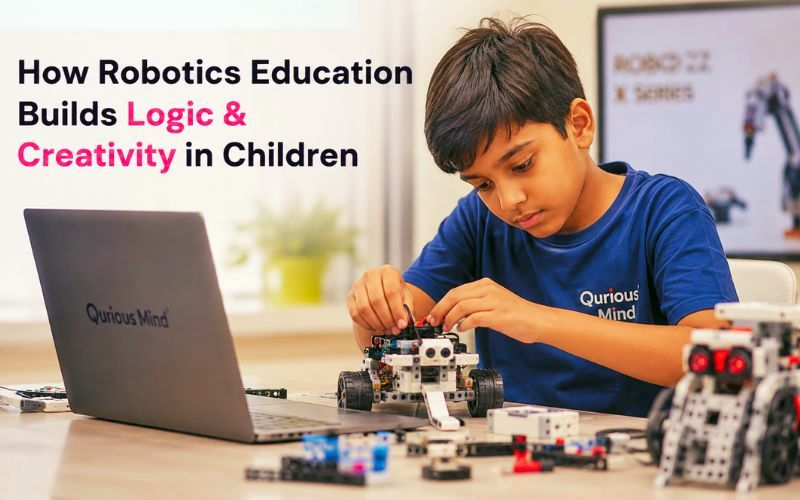
In a world where adaptability and innovation matter more than rote learning, robotics education is quietly becoming one of the most powerful tools for child development. It’s not just about wires and motors — it’s about teaching children to think, create, and solve problems that matter. Discover how Robotics Education builds Logic and Creativity in children.
Why robotics is more than a technical skill
Parents and educators often assume robotics is reserved for future engineers. In reality, the benefits of robotics for child development are wide-ranging — spanning logical thinking, creative expression, academic confidence and social skills. Whether a child dreams of becoming a designer, a scientist or an entrepreneur, robotics gives them a foundational edge.
At Qurious Mind Infotainment Pvt Ltd, our approach is simple: robotics is about building minds of the future, not just machines.
How robotics builds logical thinking
When a child programs a robot to complete a task, they’re not just pressing buttons. They are learning to break a complex goal into smaller steps, identify cause-and-effect relationships, test hypotheses and debug errors — all core elements of logical and computational thinking.
This kind of structured problem-solving directly strengthens performance in mathematics, science and even language comprehension. Children begin to approach challenges methodically, rather than impulsively.
A study published in the Computers & Education Journal found that students exposed to robotics-based learning showed a 20–30% improvement in logical reasoning and problem-solving skills compared to those in traditional classroom settings.
Computational thinking — a life skill, not just a coding skill
Robotics nurtures computational thinking across four dimensions: decomposition (breaking problems into parts), pattern recognition, abstraction and algorithmic reasoning. These skills don’t stay confined to the classroom — they shape how children approach decisions, projects and challenges throughout their lives.
The creative side of robotics — often overlooked
There is a common misconception that robotics is purely technical. The truth is, robotics is one of the most creatively demanding activities a child can engage in. Students are asked to design robot models, invent unique solutions, experiment with movement and sensors and imagine real-world applications.
A child who imagines a robot that cleans ocean waste or builds a smart traffic signal, is not just coding — they are innovating. At Qurious Mind, we deliberately create the space for children to turn imagination into working prototypes. Creativity becomes tangible, purposeful and deeply satisfying.
Learning from failure — building resilience
Robots rarely work perfectly on the first build. And that’s exactly the point. Every malfunction, every unexpected error, is an opportunity to analyse, adjust and try again. Over time, children develop a growth mindset — understanding that failure is not the end of learning; it is the beginning of it.
This kind of resilience, built through hands-on robotics challenges, prepares children for a future where adaptability is essential.
Age-wise benefits of robotics education
Ages 5–7
- Builds natural curiosity
- Develops fine motor skills
- Introduces basic logic & sequencing
Ages 8–12
- Strengthens problem-solving
- Encourages creative design
- Improves academic confidence
Ages 13–16
- Introduces coding & AI concepts
- Connects learning to real-world use
- Builds career-readiness
Robotics and teamwork — social intelligence in action
Most robotics projects are collaborative. Children learn to communicate their ideas, divide responsibilities and respect perspectives different from their own. These aren’t soft extras — they are core competencies that employers and institutions increasingly value alongside academic achievement.
Future-proofing today’s learners
The World Economic Forum estimates that 65% of today’s children will work in roles that don’t yet exist. Robotics education equips children with the technological literacy, critical thinking and innovative mindset needed to thrive in that future — whether in AI, automation, healthcare, design or fields we haven’t imagined yet.
According to UNESCO STEM reports, students engaged in robotics and hands-on STEM education demonstrate higher engagement levels and significantly improved academic confidence across subjects.
Schools across India are already integrating robotics under the NEP 2020 framework. Qurious Mind partners with institutions to deliver structured robotics programs, workshops and inter-school competitions that bring this learning to life.
Give your child a head start
At Qurious Mind Infotainment Pvt Ltd, our robotics programs are age-appropriate, curriculum-aligned and designed to nurture both logic and creativity through hands-on, challenge-based learning. Children don’t just learn robotics here — they become thinkers, creators and confident problem-solvers.
Explore our robotics courses, STEM workshops, and school partnership programs today.